Crown Molding Profiles: A Complete Guide to Choosing the Right One
By Nicholas Dunn · April 26, 2026 · 4 min read
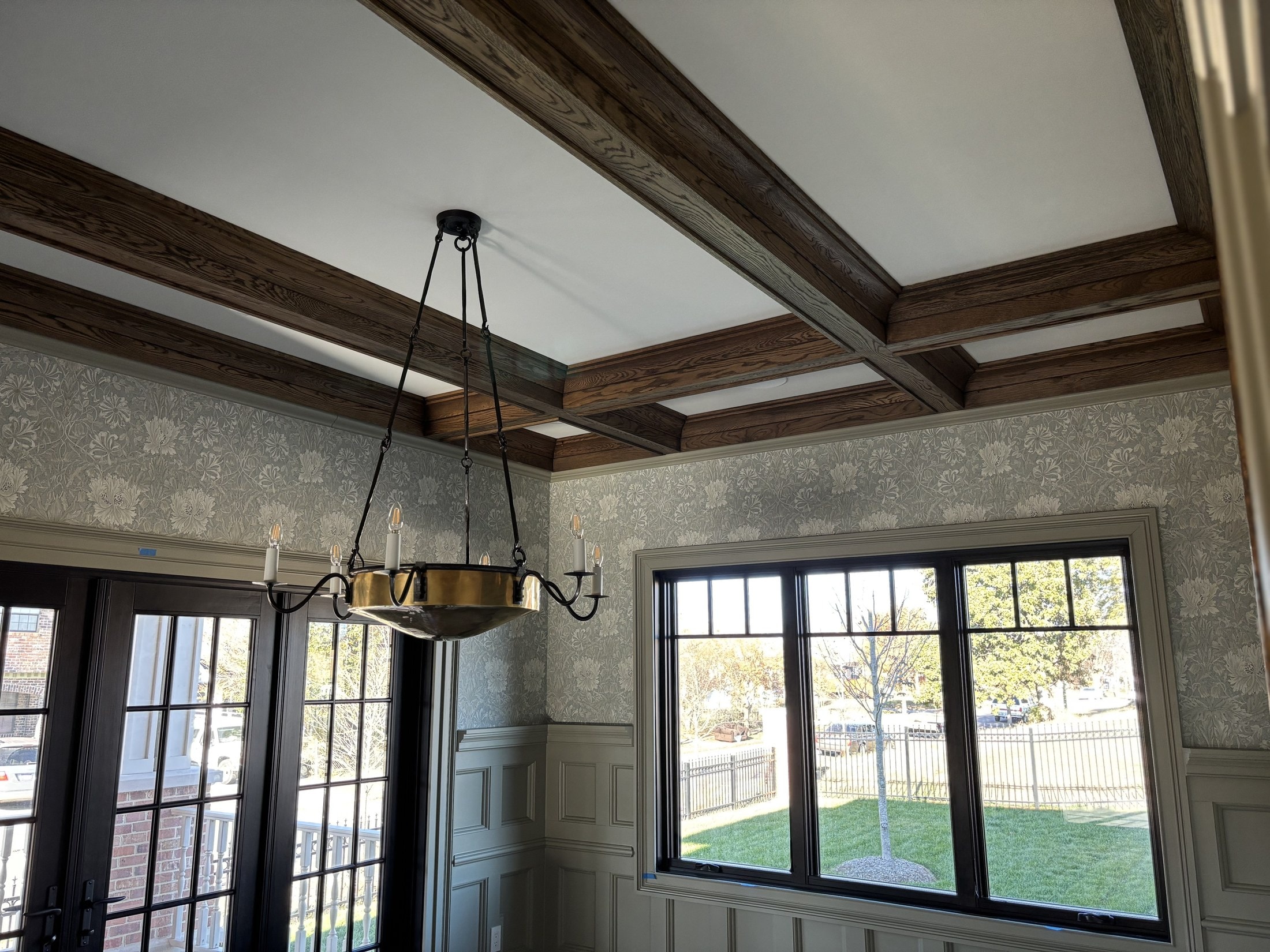
TL;DR
Crown molding can elevate a room or make it look cheap. The difference comes down to profile selection, sizing, and proportion — and most homeowners get all three wrong.
What is a "crown molding profile"?
A crown molding profile is the cross-sectional shape you see when you cut the molding and look at the end. The profile defines the visual character — whether the crown looks Federal, Colonial, Craftsman, traditional, modern, or custom.
Profiles are categorized by their geometry:
- Cove — a single concave curve. Simple, modern, restrained.
- Ogee — an S-shape combining a concave and a convex curve. Classical, used in Federal and Colonial homes.
- Bed molding — small, simple profiles often stacked with other moldings to build up scale.
- Built-up — a combination of multiple smaller moldings stacked together to create scale and depth.
- Custom-knived — a profile cut from custom millwork knives to match historic or one-off designs.
The biggest mistake homeowners make
The biggest mistake is treating crown molding like a finish material instead of an architectural element. They walk into Home Depot, pick up 12 feet of stock crown in 3.5 inches tall, and install it on 10-foot ceilings.
The result: the crown is so small relative to the room that it looks like an afterthought. The eye registers it as "trim" rather than as part of the architecture. It does nothing for the space, and in many cases actively cheapens it.
Sizing crown for ceiling height
Here is the proportional rule finish carpenters use:
- 8-foot ceilings: 3-4 inch tall crown
- 9-foot ceilings: 5-6 inch tall crown
- 10-foot ceilings: 7-9 inch tall crown
- 12-foot ceilings: 10-14 inch tall crown (often built-up, not single piece)
- 14+ foot ceilings: 14+ inch tall, built-up assemblies with multiple profile layers
These are starting points, not rules. The right answer depends on the room's overall character and the architectural style of the home.
Matching profile to architectural style
Federal / Colonial homes use formal ogee profiles, often with a dentil course or fillet integrated into the design. Built-up crown is appropriate. Profiles should feel symmetrical and classically proportioned.
Craftsman / Arts & Crafts homes often forgo traditional crown entirely in favor of a simple flat horizontal trim board or a small cove. Heavy ogee crown looks wrong in these homes.
Modern / Contemporary homes typically use no crown molding at all, or a very minimal flat reveal. A traditional profile would clash with the modern aesthetic.
Victorian homes use elaborate profiles with multiple steps, beads, coves, and often plaster ornament. The crown is meant to be intentionally ornate.
Modern Farmhouse homes vary — traditional crown in formal rooms, simple shaker-style flat trim or no crown in casual spaces.
When to build crown up
"Built-up" crown is multiple molding pieces stacked together to create a single visually-unified profile that is taller and more layered than any single piece available off-the-shelf.
You should build crown up when:
- Ceilings are 10+ feet and stock single-piece crown looks undersized
- The architectural style calls for layered classical detail
- You want the crown to be a focal element rather than a transitional one
- The room's overall scale demands more substantial trim
A well-designed built-up crown might consist of a base cove or fillet at the ceiling, a primary ogee or crown profile in the middle, and a flat or beaded element transitioning to the wall — three pieces working as one composition.
Material considerations
Crown molding comes in several materials, each with tradeoffs:
- Solid wood (poplar, pine, oak, maple) — best for stain-grade applications. More expensive. Susceptible to seasonal expansion.
- MDF (Medium Density Fiberboard) — most common for paint-grade work. Smooth finish, no grain to fight. Cuts cleanly. Damaged easily by moisture.
- Primed pine finger-jointed — a mid-tier paint-grade option. More dimensionally stable than solid pine for trim runs.
- Polyurethane / foam — lightweight, paintable, moldable. Often used for ornate profiles where wood would be cost-prohibitive. Some finish carpenters dislike the soft feel, but it has its place.
Common installation mistakes
- Inside corners that are mitered instead of coped. A mitered inside corner on crown will open up over time as the framing settles. Inside corners should always be coped.
- Outside corners that don't match. The two pieces of the outside miter should have grain or profile alignment. Mismatched pieces look amateur.
- Crown that doesn't return at terminations. When crown ends mid-wall, it needs to return back to the wall — not just stop with a square end.
- Gaps at the top. A skilled installer scribes the crown to follow ceiling irregularities. An unskilled one shoots a bead of caulk in the gap.
Bottom line
Crown molding is one of the highest-impact trim details in a room. Done well, it elevates the entire space. Done poorly, it cheapens the work and dates the home.
If you're specifying crown for a project or renovation, the size, profile, material, and installation method all need to match the architectural intent. If you're not sure where to start, a Consultation can save you from making a $5,000 mistake.
About the Author
Nicholas Dunn is a finish carpenter and the founder of Dunn Trim Co., with the better part of a decade at the saw. He helps homeowners, designers, architects, contractors, and trim companies get finish carpentry right. More about Nicholas →